


- Life top
- Daily Life
- Applying for LINE stickers
- Exhibition of Matsumoto-sensei
- Hana - Shiba-Inu
- Elec. handicraft & Akihabara
- Supermarkets in the area
- Takaido Civic Center
- Building a house
- Horrible dentists
- Judo therapy
- In an elderly care home
- Parties
- Cosplay bonenkai 2010
- Gainax cosplay bonenkai
- Friends from Gainax
- Friends from schooldays
- Party at Bar Espion
- Home party with cheese
- Music Life
- Learning to Play the Shamisen
- Jogasaki Afternoon Concert
- TARO Quartet
- Maeda-san - violin maker
- Chigusa Kindergarten
- Seniors playing music
- My viola debut
- Torakyo regular concert
- Toranomon Orchestra
- Four seasons
- Shrine visit of the New Year
- New Year´s postcard
- Snowfall in Tokyo
- Hina-matsuri and hina-dolls
- Sakura - cherry-blossom
- Sakura - what I missed most
- Fireworks Festival
- People
- Itakura - his adventurous life
- Naoto - his country life
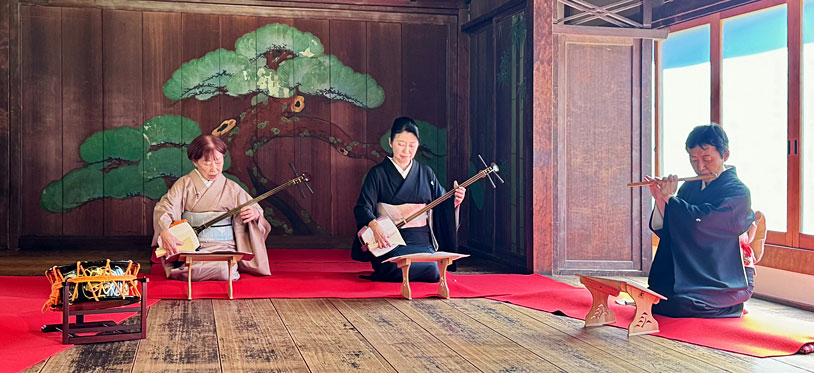
Learning to Play the Shamisen
Why the shamisen, of all things?
I have been taking shamisen lessons since this April.
My friends often ask me, "Why the shamisen, of all things?" I usually explain that it goes back to my childhood. My aunt used to perform nagauta and hauta, traditional Japanese vocal music accompanied by her own shamisen play, and I was fascinated by the way she played and by the sound of the instrument. Growing up in Japan, I was also familiar with the sounds of drums, flutes, and shamisen at bon odori festivals. Whenever I went to see kabuki, shamisen music was always part of the experience. Popular songs of the time, too, often had a strong traditional Japanese flavor. There was even Fumiko Miura, a singer who had previously worked as a geisha. Haruo Minami and Hideo Murata, both hugely popular singers who produced million-selling records, had originally performed naniwabushi, a traditional form of narrative singing. Michiya Mihashi, another enormously popular singer, had started out singing Japanese folk songs.
The shamisen, however, comes in three basic types, classified according to the thickness of the neck, and each is mainly used for a different genre of music. I grew older without ever quite figuring out which kind of shamisen music I wanted to play, or which type of shamisen I should learn. Then, two or three years ago, I began listening to rokyoku, also known as naniwabushi, I was immediately captivated by the powerful, deep sound of the shamisen used to accompany it. This is the futozao, or "thick-necked" shamisen. I learned that rokyoku was also performed at ordinary yose theaters, where various traditional forms of Japanese entertainment are presented. So I decided to go and see it for myself at Suehirotei in Shinjuku.
A yose theater is, roughly speaking, a variety show in English, or a Variete in French. I became familiar with the German Variete scene when I lived in Berlin. There were three theaters of different sizes and histories: the Wintergarten, the Chamaleon, and the Schein Bar.
Although they differed in scale and history, their programs typically included acrobatics, often as the main attraction, as well as short comic sketches, singing, and other forms of entertainment. The smaller theaters with a greater emphasis on spoken performance were often called Kabarett. The Distel and the Stachelschweine were two of the best-known examples.
Japanese yose theaters have changed considerably over the course of their history, but today, at least in Tokyo, the main attractions are rakugo, a form of comic storytelling, along with kodan, a traditional form of narrative storytelling, and rokyoku, or naniwabushi. There are also various acts known collectively as iro-mono, or "variety acts", such as acrobatics and hauta and kouta, as well as spoken performances such as manzai and comic monologues.
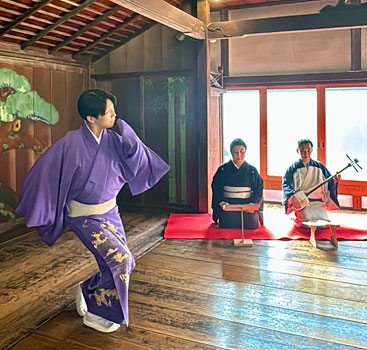
A professional dancer joined us as a guest and performed to our accompaniment.
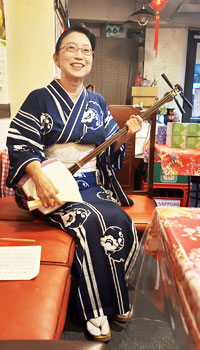
Our shisho performing at a night session.
I have gone into rather a lot of detail, but it was hauta and kouta that turned out to be what I had been looking for. It is a genre in which a performer uses a single shamisen - the hosozao, or thin-necked shamisen - to accompany songs such as hauta, kouta, zokkyoku, and shin-min'yo, while also engaging in a little conversation with the audience. In essence, these are songs that were widely sung and enjoyed in the pleasure districts from the Edo period through the Meiji period and into the middle of the Showa period, with the shamisen providing the accompaniment.  After the beginning of the Showa period, the world of popular songs - and eventually J-pop - came to be dominated by songs written by professional composers commissioned by record companies and then distributed through records and radio. But before that era, there were songs that ordinary people sang and that became popular through everyday life. It was this older tradition of shamisen music that I had always felt drawn to.
It is quite different from music such as gidayu and nagauta, which were also traditional shamisen music but developed primarily as accompaniment for kabuki, bunraku, and other traditional theatrical arts. The songs of hauta and kouta are much simpler and shorter. Originally, this was intimate music enjoyed in small rooms at restaurants and other establishments, where geisha and their guests could relax and enjoy themselves together. It was often performed for just one listener at a time. And the performer was not necessarily the geisha: a guest who knew how to be "iki" might pick up the shamisen himself, sing while accompanying himself, and use the music to court the geisha. In Western terms, it is perhaps closest to a singer accompanying himself or herself on the guitar for an intimate audience of one.
The Meiji government considered this kind of music unsuitable for promoting national pride. It therefore excluded shamisen music from public and educational settings and instead promoted Western music. As a result, shamisen music gradually moved away from the mainstream of Japanese cultural life. The final blow came with the enactment of the Anti-Prostitution Law in 1958. As the traditional pleasure districts, including Yoshiwara, disappeared, this kind of shamisen music also gradually vanished from the public stage. The two developments went hand in hand.
Even today, however, there are people who still feel an attachment to this kind of traditional Japanese entertainment. I am one of them. With whatever time I have left in my life, I decided to return to this aspect of Japanese culture. I searched online and, fortunately, found that there was a school of the Asakawa-kai (Japanese only) nearby where I could learn kouta and hauta. So I went to observe a lesson and immediately decided to be a student of the teacher Asakawa Tamaki.
The teacher lives in Niigata, but once a month she comes to Tokyo and stays for about ten days, giving lessons to her students here. She had lived around Koenji when she was a student at Waseda University. After graduating, she worked as an office worker, and for a time she also performed at yose theaters. She eventually returned to Niigata, where she now teaches shamisen and has students both there and in Tokyo. She had been interested in Yoshiwara since her university days. Not only did she study Yoshiwara as an academic subject, but she also has an extensive shamisen repertoire associated with Yoshiwara and its history.
When learning a traditional Japanese art, the terminology is different from that used for ordinary lessons. The teacher is a shisho, the student a deshi, and practice is called keiko. You are supposed to use these traditional terms. Before the war, the phrase "a kouta shisho" often conjured up an image of a mistress kept by a wealthy patron who taught shamisen and sang as a sideline. My own shisho, Asakawa Tamaki, is of course nothing of the sort. But she is a gentle, graceful, and approachable woman who fits the traditional image of a "kouta shisho" remarkably well.
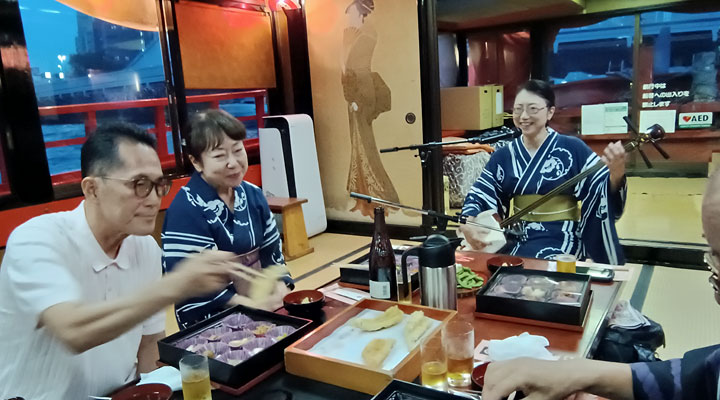 Shisho started off the evening's entertainment while her students were busy eating.
The reality of shamisen learning
So I bought a shamisen, and at my very first keiko, I started with “Sakura Sakura,” a song that virtually every Japanese person knows, trying to play it from the shamisen notation, which I was seeing for the first time. I have keiko once a month, and each time I am given a new song to practice at home before the next lesson. But the songs have all been unfamiliar to me: “Sutoton-bushi,” “Gicchonchon,” “Karakasa,” “Namiki Komagata,” and so on. Many of them are playful songs about romantic relationships between men and women, and even the turns of phrase have a strong flavor of old Edo.
Even today, however, there are people who still feel an attachment to this kind of traditional Japanese entertainment. I am one of them. With whatever timeFor me, the difficult part is not so much the technique of playing the shamisen itself as the fact that I am expected to sing while accompanying myself on the instrument. Unlike Western music, the shamisen accompaniment and the singing are supposed to be slightly out of sync. Traditional Japanese music does not use harmony, and the shamisen basically plays single notes, so if the voice and shamisen were perfectly synchronized, the result would apparently sound too simple. But for someone like me who has spent years playing Western music and concentrating on keeping the vertical lines together, this is surprisingly difficult.
As is customary with this kind of school, there is a recital for the students. At the Asakawa-kai, it is held twice a year and has the rather grand name of the Kensan-kai, literally a “gathering for the pursuit of mastery”. I had only just started learning when the first one was held, so I did not perform but went simply to watch. It was held at a private Noh theater near Shinjuku, and the whole event had a wonderfully traditional Japanese atmosphere. The next one will be in December, and this time I will have to show what I have learned.
The keiko and the recitals are not the only things we do. My shisho also comes up with various kinds of entertainment for us. In July, for example, we gathered at Koumien, one of our keiko venues, for a Taiwanese dinner while listening to a live performance by our teacher. The proprietress of Koumien is Taiwanese herself, but she is also learning shamisen from my shisho. Through that connection, she lets us use her restaurant as a practice venue on its regular days off. Thanks to her Taiwanese connections, a group of volunteers apparently even went on a concert tour of Taiwan last year! At the recitals, she performs Taiwanese folk songs while accompanying herself on the shamisen. The shamisen is said to have originally come to Okinawa from the Fujian region of China. So, I wonder why it never made its way to Taiwan, whose people have such strong historical connections with Fujian. Apparently, the shamisen is not played in Taiwan today.
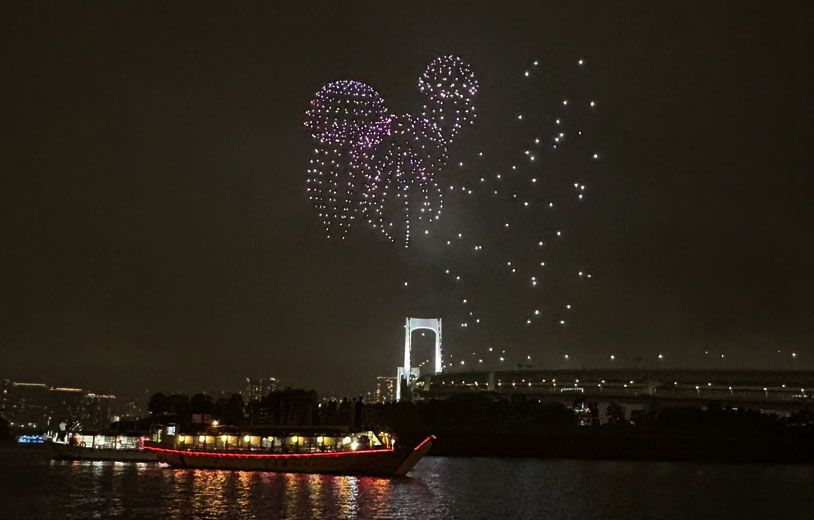
Then, at the end of August, we enjoyed a traditional houseboat cruise from Yanagibashi. On these cruises, it is common for passengers to spend the evening singing karaoke. At the Asakawa-kai, however, our teacher and students provide the music on shamisen and drums, while one of the students - who was the first president of Waseda University's Rakugo Research Society - gives a remarkably professional rakugo performance. After that, we enjoy various traditional ozashiki entertainments and feast on drinks, appetizers, and tempura provided by the boat operator. Students bring along their families and friends, too, and from Yanagibashi to Odaiba, we spend an evening indulging in the kind of pleasure once enjoyed by wealthy patrons of the old days.
Well, this is what everyday life is like at a shamisen school. The students are overwhelmingly women, and most are older people. But perhaps this is how Japanese traditions continue to be passed down: not through grand institutions, but quietly, from one generation to the next, in places like this.
 2026.08.30