


- Life top
- Daily Life
- Applying for LINE stickers
- Exhibition of Matsumoto-sensei
- Hana - Shiba-Inu
- Elec. handicraft & Akihabara
- Supermarkets in the area
- Takaido Civic Center
- Building a house
- Horrible dentists
- Judo therapy
- In an elderly care home
- Parties
- Cosplay bonenkai 2010
- Gainax cosplay bonenkai
- Friends from Gainax
- Friends from schooldays
- Party at Bar Espion
- Home party with cheese
- Music Life
- Learning to Play the Shamisen
- Jogasaki Afternoon Concert
- TARO Quartet
- Maeda-san - violin maker
- Chigusa Kindergarten
- Seniors playing music
- My viola debut
- Torakyo regular concert
- Toranomon Orchestra
- Four seasons
- Shrine visit of the New Year
- New Year´s postcard
- Snowfall in Tokyo
- Hina-matsuri and hina-dolls
- Sakura - cherry-blossom
- Sakura - what I missed most
- Fireworks Festival
- People
- Itakura - his adventurous life
- Naoto - his country life
Jogasaki Coast Afternoon Concert
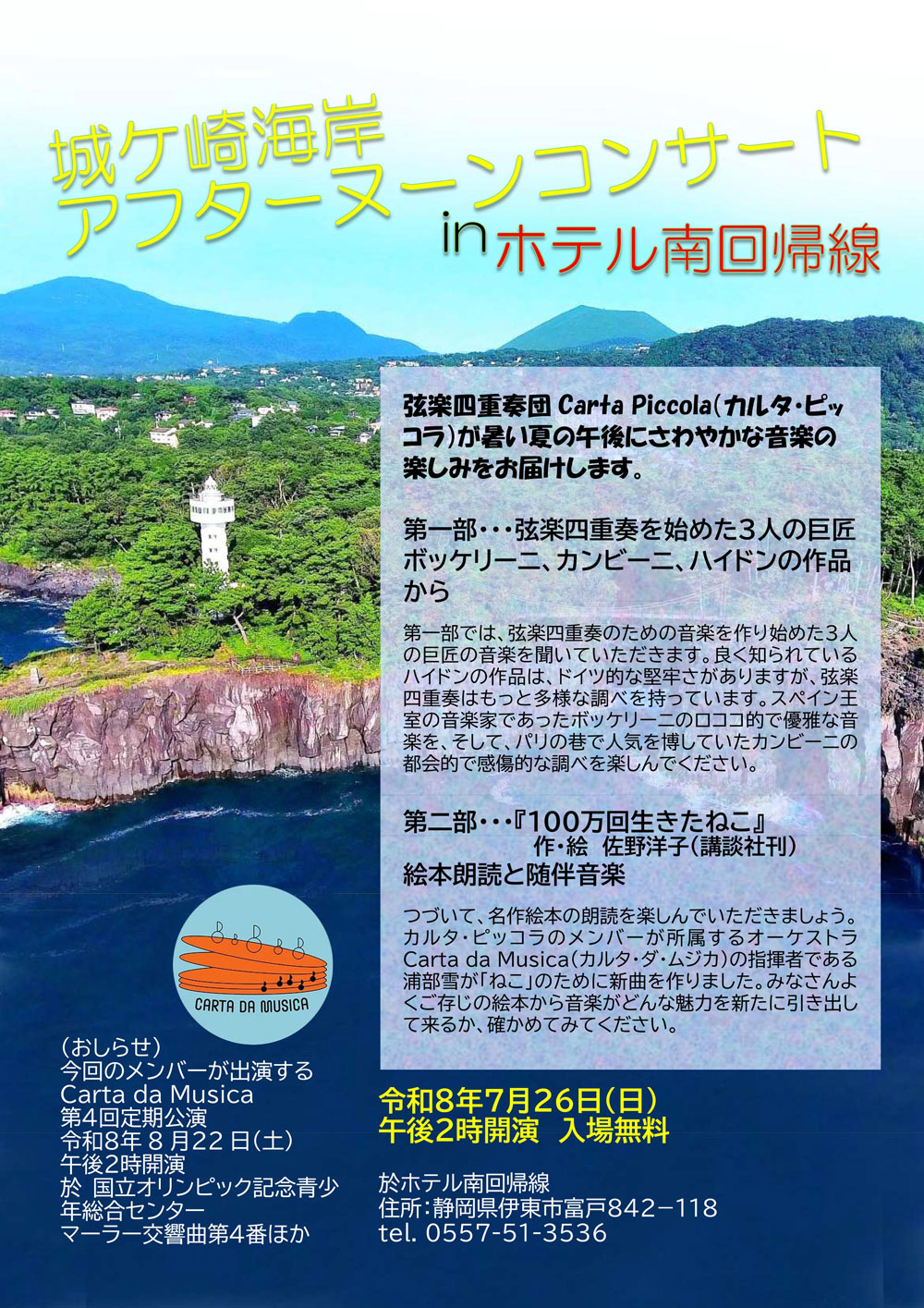
On July 26, I gave an concert at the dining hall of Minami-Kaikisen in Izu Kogen. The hall was filled with about fifty people, and their warm, enthusiastic applause made the afternoon a memorable one for all of us.
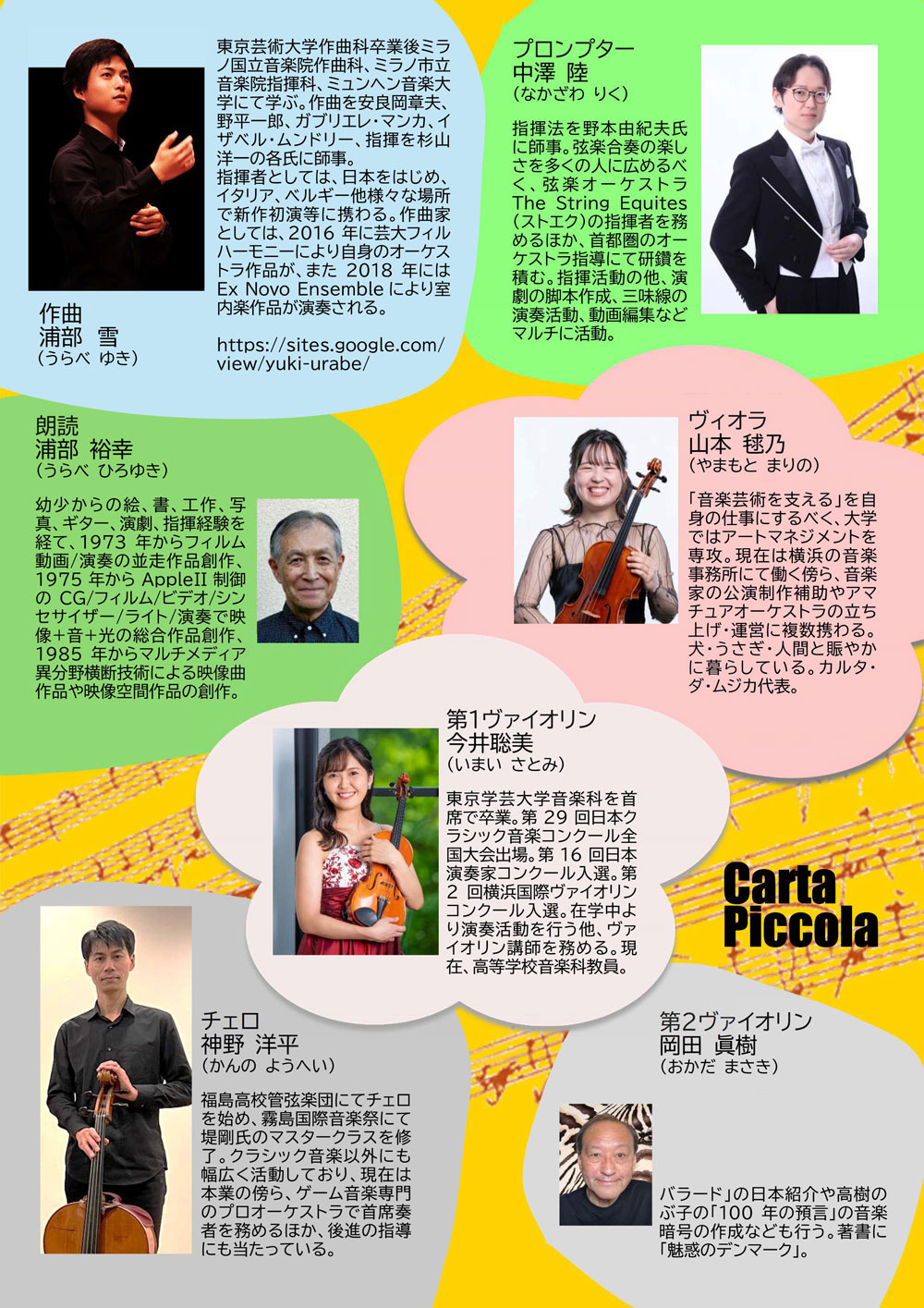
This was the third time I had presented a concert at Minami-Kaikisen. Although the members have been different each time, the heart of the performance has always been a string quartet. For this concert, I invited several friends from Carta da Musica, the orchestra I joined when it was founded last year. Satomi, our concertmaster, played first violin; Marino, who is also the orchestra's director, played viola; Kanno, the principal cellist of a professional game music orchestra, played cello; and I took the second violin part. Satomi and Marino are both still in their mid-twenties, and Kanno is also a young musician who was recently married.
This concert was also a little different from the previous ones in terms of its musical program. The centerpiece was a multimedia performance based on the beloved picture book "The Cat That Lived a Million Times". While images from the book were projected onto a screen, the story was read aloud, accompanied by music performed live by our string quartet. It is not easy to describe this kind of performance because it does not really fit into any established genre. Perhaps the simplest way to introduce it is: "A journey into a classic picture book through images, narration, and live music."
How did the idea take a concrete shape?
The idea actually goes back more than twenty years, to the time when I was living in Frankfurt. I wondered whether German adults who had little interest in Japanese anime or manga might be more open to Japanese picture books. When I finally decided to put the idea into practice, it occurred to me that simply reading the stories aloud might not be enough to hold the audience's attention. So I added live incidental music, beginning with the simplest possible accompaniment?a violin duet. The idea worked better than I had expected, and over the years I introduced many different Japanese picture books in this way.
A few years ago, I began to wonder whether the same approach might also appeal to Japanese audiences. I asked Yuki Urabe, who graduated from the composition department of the Tokyo University of the Arts, continued his studies in Milan and Munich, and returned to Japan at the end of 2024, to compose the music for The Cat That Lived a Million Times. For the past several years, I have been giving string quartet performances several times a year for a senior citizens' association in Musashino City, and while looking for a fresh musical project for our audience, I remembered what I had done in Germany twenty years earlier.
The performance in Musashino was received far more warmly than I had expected. Word soon reached Satomi and Marino of Carta da Musica, where Yuki is our conductor. They both said they would love to perform a work written by our own conductor, and with Kanno joining us on cello, the idea of presenting the performance as a concert at Minami-Kaikisen naturally took shape.
Originally, the narration was to be given by the composer's father, an old classmate of mine from both junior high and high school. Unfortunately, after the concert flyers had already been printed, he became seriously ill and had to withdraw. At very short notice, I asked another classmate from the same high school, Ms. Yao, to step in.
Although she is not a full-time professional narrator, she has extensive experience giving readings at a wide variety of events. At the end of 2024, she gave a wonderful reading of a fairy-tale-style narration accompanying Schumann's Carnaval, and her performance was truly outstanding. She had also been the narrator when we first presented The Cat That Lived a Million Times in Musashino, so when we suddenly needed a replacement, she was the one person I knew I could rely on.Preparation for the concert started.
The picture-book performance with narration and live music lasts for less than thirty minutes, so by itself it would have been too short for a full concert. We therefore added a first half introducing the string quartet as a musical genre, together with works by three of its great early masters: Haydn, Boccherini, and Cambini, all of whom played important roles in the development of the string quartet during the late eighteenth and early nineteenth centuries.
We chose Luigi Boccherini's String Quartet in G major, G.164, and Giuseppe Maria Cambini's String Quartet, T.169 - works that may well have received their Japanese premieres at this concert. In Japan, where the classical repertoire has traditionally been viewed through a strongly German lens, I have long hoped that more listeners would discover the richness and elegance of the Italian tradition, the very birthplace of classical music. Our choice of repertoire reflected that hope.
In contrast to the first half of the concert, which explored the early history of the string quartet, the second half brought the audience into the present day with The Cat That Lived a Million Times. The accompanying music had been composed only the previous year, in 2025. Since the Cat's theme is based on a waltz - although in a highly transformed form - we chose, as our encore, another contemporary work inspired by the same dance: the Waltz from Suite Porpora, composed in 2017 by the Italian composer Davide Piero Runcini.
As a concert venue, Minami-Kaikisen was an ideal choice. Although it is a little way from Tokyo, it is located in the pleasant resort area of Izu Kogen, where many people who own holiday homes spend their weekends. I felt that such an audience would be especially receptive to this kind of program, so I asked my friends Mr. and Mrs. Mizuno if we could use the restaurant they run. They very kindly agreed.
As for the music itself, I had jokingly asked Yuki to keep the technical demands modest, since it would be performed by amateur players. He politely ignored my request. The music he wrote was wonderfully expressive, but it proved much more challenging than I had expected. This time, apart from me, a retired pensioner, everyone in the quartet is a busy professional musician, so the technical difficulties were easily overcome. But, simply finding rehearsal dates that suited everyone was a challenge in itself. Nevertheless, we somehow managed to rehearse together three times, with Yuki coaching us personally and explaining exactly what he wanted. Little by little, the performance really came together.
One rehearsal took place at my home under Yuki's guidance. By chance, Ana, who lives nearby, dropped in to observe. She will be playing in Carta da Musica's regular concert this season. Ana is from Spain and studied music in the Netherlands, where she even had the opportunity to perform on the stage of the Concertgebouw. Although she has been in Japan for only about six months, her Japanese is already remarkably good, and we were able to converse mostly in Japanese.
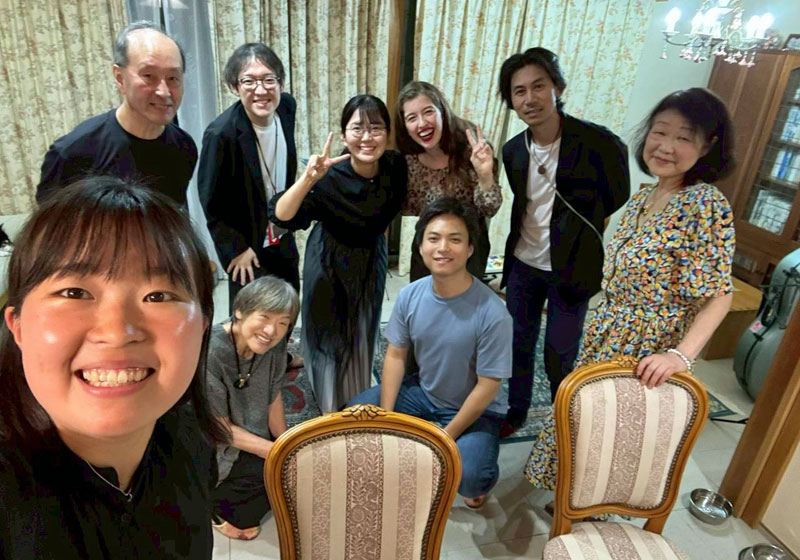
After the rehearsal at my home
The days in Minami-Kaikisen
Of the six people involved in the performance, four of us (or seven, including family members) stayed overnight at Minami-Kaikisen before the concert, enjoying a little holiday atmosphere. Satomi, our first violinist, even took her parents to the nearby Akazawa Onsen before joining us, where they relaxed in the open-air bath overlooking the Pacific Ocean.
My own "holiday," however, consisted mainly of solving practical problems. As the organizer, I spent the previous day working with the Minami-Kaikisen staff to prepare the hall. The dining room has magnificent windows with beautiful views over the Izu landscape, but no curtains. That was wonderful for the scenery, but rather inconvenient for projecting pictures from the book. After trying several ideas, we improvised a surprisingly effective solution. We clipped together several coloured bed sheets and hung them across the sunlit windows to block much of the daylight. A whiteboard became our projection screen, and because one of the windows behind it could not be completely covered, we even leaned an aluminium bath cover against the glass to reduce the remaining light. Somehow, we managed to reach a happy compromise: the projected illustrations were clearly visible, while there was still enough natural light for the musicians to read their music without additional stage lighting.
Just as everything seemed to be under control, we received worrying news. Nakazawa, who was responsible for operating the projected images and cueing the narrator, had left Tokyo after work but was stranded in Atami. A sudden thunderstorm had brought train services beyond Atami to a halt. After waiting for more than two hours, a single train was finally allowed to continue to Izu Kogen at around ten o'clock that evening. He eventually reached Minami-Kaikisen just before midnight.
On the morning of the concert, those of us who woke early took a walk along the spectacular Jogasaki Coast. Afterwards, our hosts prepared a truly wonderful breakfast: freshly baked bread, chilled fruit soup, delicious ham, a cheese souffle, two colorful salads, homemade ice cream in two flavors, and excellent coffee. It was a luxurious way to begin the day.
While everyone else continued setting up the hall, I drove to Ito Station to collect Ms. Yao, our narrator, and Marino, our violist. Rehearsal on stage began at 10:30 a.m. We made a last-minute decision to amplify the narration with a microphone, which meant hurriedly adjusting the sound system before we could begin. By the time rehearsal finished, shortly after one o'clock, our first audience members had already started to arrive. We quickly changed into concert dress and grabbed the lunches we had brought with us.
The Cat That Lived a Million Times tells the story of a cat who lives a million lives. Again and again he dies, and again and again he is reborn. Throughout those countless lives, he loves no one but himself. Only when he finally learns to love another does the endless cycle of rebirth come to an end.
- Once he belonged to a king.
- Once he belonged to a sailor.
- Once he belonged to a circus.
- Once he belonged to a little girl.
.
.
Then he fell in love with a beautiful white cat.
- To impress her, he even turned somersaults before her.
- Waltz
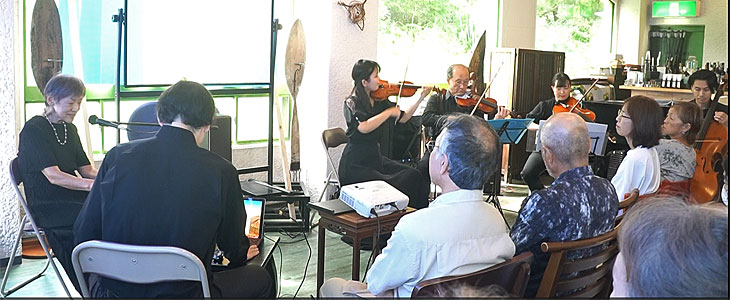
The concert began at two o'clock and turned out even better than we had hoped. The audience responded warmly throughout, and the performance was a great success. Afterwards, I would have loved to relax for a while and enjoy the afterglow of the concert. Our hosts had even prepared chilled watermelon for everyone. But some members of the ensemble had evening commitments, so instead I hurried them into my car and drove straight to Ito Station.
The concert itself may have ended there, but for us it continued on LINE, where photos were shared, messages flew back and forth, and everyone agreed on one thing: we had had a wonderful time making music together.
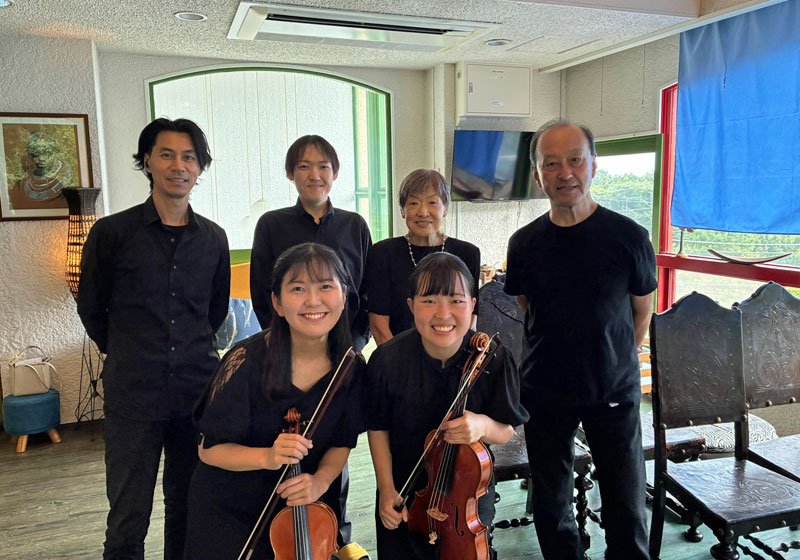
After the concert. The blue sheet on the right did shield us from the strong sun
 2026.07.28