


- Life top
- Daily Life
- Exhibition of Matsumoto-sensei
- Hana - Shiba-Inu
- Elec. handicraft & Akihabara
- Supermarkets in the area
- Takaido Civic Center
- Building a house
- Horrible dentists
- Judo therapy
- In an elderly care home
- Parties
- Cosplay bonenkai 2010
- Gainax cosplay bonenkai
- Friends from Gainax
- Friends from schooldays
- Party at Bar Espion
- Home party with cheese
- Music Life
- String ensemble gathering
- TARO Quartet
- Maeda-san - violin maker
- Chigusa Kindergarten
- Seniors playing music
- My viola debut
- Torakyo regular concert
- Toranomon Orchestra
- Four seasons
- Shrine visit of the New Year
- New Year´s postcard
- Snowfall in Tokyo
- Hina-matsuri and hina-dolls
- Sakura - cherry-blossom
- Sakura - what I missed most
- Fireworks Festival
- People
- Itakura - his adventurous life
- Naoto - his country life
String Ensemble Gathering
- improving the performance skills of orchestral string players and fostering their friendship
On Saturday the 20th, twenty-four string players from my local amateur orchestra, Ensemble Sonare, gathered for a chamber music event. We did not invite any outside audience members. The performers themselves became the audience whenever they were not playing. This time, we used the hall at Hamadayama Kaikan and, starting at 9:00 a.m., performed thirteen string quartets and one string trio?a total of fourteen pieces?each lasting about seven to eight minutes. We concluded by playing the first movement of Eine kleine Nachtmusik together as an ensemble before heading off to a lunch gathering.
This was the second time we had held a "String Ensemble Gathering." The first was on November 4, the year before last, so this was the second event in nearly a year and a half. The original idea was mine, and with the help of three female violinists and one male cellist, I planned and organized the event.
What prompted me to start something like this was my role as principal of the second violin section in Ensemble Sonare, where I became responsible for looking after the other second violinists. In a typical amateur orchestra, most second violinists have relatively limited experience, either with violin playing itself or with orchestral performance. Many may have played a little when they were young and only recently resumed, while others may have taken up the violin after retirement as a new challenge later in life.
As a result, I began organizing occasional sectionals for the second violins, offering advice and guidance during our practice sessions. To my surprise, these sessions proved quite popular. Later, when I created a LINE group for the second violin section, it became more than just a channel for administrative announcements; members also started chatting informally. Before long, people throughout the orchestra were commenting on how friendly and harmonious the second violin section seemed.
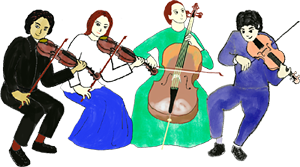
logo of the gathering
In short, a sense of camaraderie developed because we were doing more together than simply showing up for orchestra rehearsals and sitting side by side to play. By sharing a variety of activities and experiences, we became a genuine community.
In an orchestra, string players perform the same part with multiple musicians playing simultaneously, whereas each wind player typically performs an individual part on their own. As a result, especially for those seated toward the back of the section, there is a tendency to pay less attention to the ensemble balance and interaction with the other sections. Moreover, when players encounter passages they cannot play well, they can sometimes get by simply pretending to play. I thought that one way to address these issues would be to have each player take responsibility for an individual part by practicing string quartets, string trios, or even duos - settings in which one cannot avoid thinking about the ensemble as a whole - and then perform these pieces in an informal recital for fellow members. When I asked around, I found that interest was surprisingly high.
The problem, however, was that many members lacked experience and did not know what pieces would be suitable to play. They also felt that assembling groups of players was difficult.
To solve this, I selected a list of candidate works and asked participants to choose the pieces they wished to perform. We then assigned players to each piece, and this became the basis for the first event. The participants were heavily concentrated among the violinists, while there were only two violists, including myself. As a result, we organized the program around eight violin duos, eight string quartets, and two works requiring three violins.
Even so, the event was very well received, and many participants asked for it to be repeated. I therefore considered making string ensemble performance a regular activity by holding a recital midway through the rehearsal period for each Ensemble Sonare subscription concert, which takes place roughly every eight months. However, by the time of the next subscription concert, there was no one besides me available to play the viola, so the plan had to be abandoned.
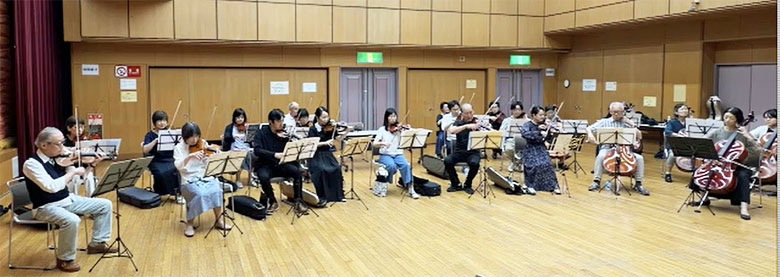
Eine kleine Nachtmusik bevore lunch
A year and a half after the first event, two additional violists besides myself agreed to participate, making it possible to hold a second gathering. By chance, we also had a favorable balance of players - fourteen violinists and seven cellists - so I decided to make the string quartet the core format and discontinued the violin duos.
Having already gone through the process once, the preparations proceeded smoothly. We had two coordinators responsible for securing venues, one in Suginami Ward and one in Setagaya Ward. One person handled the finances, and another was in charge of filming the performances for our records. As for me, I focused on selecting the repertoire, arranging the post-performance lunch gathering, and maintaining the ensemble event’s website. One of the more demanding tasks for the organizers was collecting everyone’s preferences and coordinating the dates and locations for the two rehearsal sessions, but fortunately this also went smoothly.
There was, however, one unexpected incident. The day before the event, one of the violinists informed us that she had come down with a cold and a high fever and therefore had to withdraw at the last minute.
As a result, I stepped in to play her part in the second movement of Rosamunde. Despite the rainy weather, I brought a violin in addition to my viola and performed the piece with the other members without any prior rehearsal together. Since this was not a public concert, we took it all in good humor.
Listening to everyone's performances, I noticed that there were still plenty of technical shortcomings. As is often the case with amateur musicians, intonation was generally not as accurate as it should have been, and the contrasts in dynamics were sometimes lacking. Nevertheless, compared with the first gathering, there was at least some noticeable improvement.
What was particularly encouraging was that, this time, participants did not limit themselves to the two rehearsals arranged by the organizers. I could see that many groups had taken the initiative to rehearse on their own as well. Isn't that impressive? Their enthusiasm was truly remarkable.
What pleases me most is that, through the rehearsals, the performances, and the social lunch afterward, people made friends across different sections of the orchestra and developed a genuine sense of fellowship. In activities such as an amateur orchestra, making music is important, of course, but it is equally important to build friendships with people who share the experience and with whom one can talk and spend time. As for me, participating in the ensemble gathering does not necessarily provide some extraordinary musical experience. What I value most is that these activities have allowed me to get to know all of my fellow string players better, to talk with them more often, and to become closer friends with them.
In July, the organizers will hold a thank-you lunch to recognize everyone’s efforts. While the purpose is to review and evaluate this year’s ensemble gathering, it will also serve as the starting point for planning the next one.
 2026.06.25